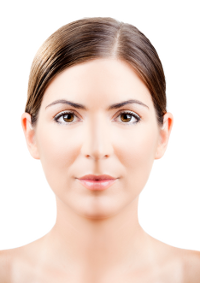
1What's the difference between the two photos of the girl in A and B?
2Who are the women in C and D?
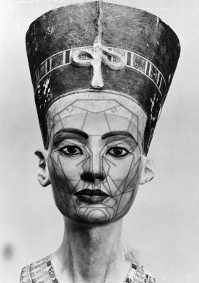
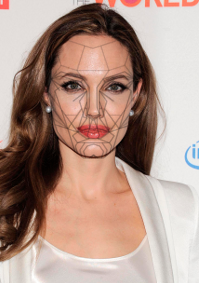
3What do you think the lines on the images show?

A
B
C
D

It's often said that 'beauty is in the eye of the beholder,' and our ideas of attractiveness certainly depend on personal preferences. Nevertheless, there are faces which most people agree are very beautiful or handsome. Is this something that we just feel about a certain face, or does it mean that there are 'rules' for what makes someone look beautiful?
It was long thought that symmetry was the key to explaining beauty. If the two halves of a face are symmetrical, we find it pleasing. There is also a deeper reason why symmetry is desirable to someone looking for a partner of the opposite sex, especially when a girl is looking for a boy. A symmetrical face and body suggests that someone's genes must be in very good condition, and that their children will be strong and healthy.
Increasing amounts of symmetry enhance the attractiveness of a face, but recent experiments have revealed that there is a limit to this. When one side of a person's face is used in a mirror image in a photograph to make a perfectly symmetrical face, the result can make us feel uneasy (photo B). It seems too unnatural, and we even begin to find it unattractive.
For a better explanation of what makes a face appear ideal, we need to enter the world of mathematics. The Greek mathematician Euclid developed his theory of the 'golden ratio' in 300 BC. He saw that if you measure different parts of many of the things we find beautiful in nature – flowers and sea shells for example – and divide the measurements by each other, you keep finding the same ratio. This golden ratio is 1.62.* It was used when the Greeks designed the Parthenon in Athens, which is considered to be one of the most perfect buildings ever built.

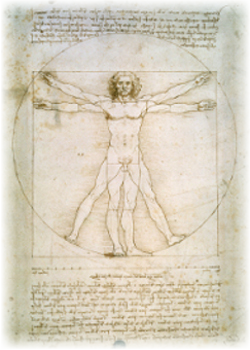
Leonardo da Vinci used the golden ratio in the lengths of each part of the body of his perfect man, and when he painted the Mona Lisa. The ratio is easily found when measuring the different parts of a beautiful face. If the height of a face divided by its width comes to 1.62, it will be seen as perfectly shaped. If the distance from
the top of the head to the pupils of the eyes, divided by the distance from the pupils to the lips is 1.62, that is also perfect. The ideal width of the central teeth compared to the next teeth? 1.62. There are numerous opportunities for the golden ratio to appear in a face. Dr Stephen Marquardt, a surgeon, developed a 'mask' that can be put on top of a photo of a face to show how close it comes to 'perfect beauty.'
The power of the golden ratio is so great that it appears to work across cultures and across time. Queen Nefertiti of ancient Egypt (photo C) was clearly just as successful an example of the golden ratio as Angelina Jolie is today (photo D). And although different cultures show strong preferences for particular eye and hair colours in their ideals of beauty, the impact of the golden ratio is the same for both men and women.
Magazines know all about this of course, and photographs of beautiful models are usually manipulated to appear even more beautiful by moving the nose, or an eye, a millimetre across, up or down. And there are apps which allow you to upload a photograph and get a score for how closely a face matches the golden ratio. Don't be too disappointed if your score seems low, though. No one is perfect, and of course, there are people with asymmetrical faces and less than golden ratios who many people find incredibly attractive!
*The full number, called phi, is similar to the better known number pi – neither can be fully calculated. Phi is actually 1.6180339887… never-ending.
It's often said that 'beauty is in the eye of the beholder,' and our ideas of attractiveness certainly depend on personal preferences. Nevertheless, there are faces which most people agree are very beautiful or handsome. Is this something that we just feel about a certain face, or does it mean that there are 'rules' for what makes someone look beautiful?
It was long thought that symmetry was the key to explaining beauty. If the two halves of a face are symmetrical, we find it pleasing. There is also a deeper reason why symmetry is desirable to someone looking for a partner of the opposite sex, especially when a girl is looking for a boy. A symmetrical face and body suggests that someone's genes must be in very good condition, and that their children will be strong and healthy.
Increasing amounts of symmetry enhance the attractiveness of a face, but recent experiments have revealed that there is a limit to this. When one side of a person's face is used in a mirror image in a photograph to make a perfectly symmetrical face, the result can make us feel uneasy (photo B). It seems too unnatural, and we even begin to find it unattractive.
For a better explanation of what makes a face appear ideal, we need to enter the world of mathematics. The Greek mathematician Euclid developed his theory of the 'golden ratio' in 300 BC. He saw that if you measure different parts of many of the things we find beautiful in nature – flowers and sea shells for example – and divide the measurements by each other, you keep finding the same ratio. This golden ratio is 1.62.* It was used when the Greeks designed the Parthenon in Athens, which is considered to be one of the most perfect buildings ever built.
Leonardo da Vinci used the golden ratio in the lengths of each part of the body of his perfect man, and when he painted the Mona Lisa. The ratio is easily found when measuring the different parts of a beautiful face. If the height of a face divided by its width comes to 1.62, it will be seen as perfectly shaped. If the distance from the
top of the head to the pupils of the eyes, divided by the distance from the pupils to the lips is 1.62, that is also perfect. The ideal width of the central teeth compared to the next teeth? 1.62. There are numerous opportunities for the golden ratio to appear in a face. Dr Stephen Marquardt, a surgeon, developed a 'mask' that can be put on top of a photo of a face to show how close it comes to 'perfect beauty.'
The power of the golden ratio is so great that it appears to work across cultures and across time. Queen Nefertiti of ancient Egypt (photo C) was clearly just as successful an example of the golden ratio as Angelina Jolie is today (photo D). And although different cultures show strong preferences for particular eye and hair colours in their ideals of beauty, the impact of the golden ratio is the same for both men and women.
Magazines know all about this of course, and photographs of beautiful models are usually manipulated to appear even more beautiful by moving the nose, or an eye, a millimetre across, up or down. And there are apps which allow you to upload a photograph and get a score for how closely a face matches the golden ratio. Don't be too disappointed if your score seems low, though. No one is perfect, and of course, there are people with asymmetrical faces and less than golden ratios who many people find incredibly attractive!
*The full number, called phi, is similar to the better known number pi – neither can be fully calculated. Phi is actually 1.6180339887… never-ending.
1has two sides that are not the same in size or shape
2changed something to do what you want
3many
4not relaxed or comfortable
5added more detail and information to an idea or story
6has two sides that are the same in shape and size
7giving you pleasure or satisfaction
8the best possible
9units of information inside a cell of a living thing which controls what it will be like
It's often said that 'beauty is in the eye of the beholder,' and our ideas of attractiveness certainly depend on personal preferences. Nevertheless, there are faces which most people agree are very beautiful or handsome. Is this something that we just feel about a certain face, or does it mean that there are 'rules' for what makes someone look beautiful?
It was long thought that symmetry was the key to explaining beauty. If the two halves of a face are symmetrical, we find it pleasing. There is also a deeper reason why symmetry is desirable to someone looking for a partner of the opposite sex, especially when a girl is looking for a boy. A symmetrical face and body suggests that someone's genes must be in very good condition, and that their children will be strong and healthy.
Increasing amounts of symmetry enhance the attractiveness of a face, but recent experiments have revealed that there is a limit to this. When one side of a person's face is used in a mirror image in a photograph to make a perfectly symmetrical face, the result can make us feel uneasy (photo B). It seems too unnatural, and we even begin to find it unattractive.
For a better explanation of what makes a face appear ideal, we need to enter the world of mathematics. The Greek mathematician Euclid developed his theory of the 'golden ratio' in 300 BC. He saw that if you measure different parts of many of the things we find beautiful in nature – flowers and sea shells for example – and divide the measurements by each other, you keep finding the same ratio. This golden ratio is 1.62.* It was used when the Greeks designed the Parthenon in Athens, which is considered to be one of the most perfect buildings ever built.
Leonardo da Vinci used the golden ratio in the lengths of each part of the body of his perfect man, and when he painted the Mona Lisa. The ratio is easily found when measuring the different parts of a beautiful face. If the height of a face divided by its width comes to 1.62, it will be seen as perfectly shaped. If the distance from the
top of the head to the pupils of the eyes, divided by the distance from the pupils to the lips is 1.62, that is also perfect. The ideal width of the central teeth compared to the next teeth? 1.62. There are numerous opportunities for the golden ratio to appear in a face. Dr Stephen Marquardt, a surgeon, developed a 'mask' that can be put on top of a photo of a face to show how close it comes to 'perfect beauty.'
The power of the golden ratio is so great that it appears to work across cultures and across time. Queen Nefertiti of ancient Egypt (photo C) was clearly just as successful an example of the golden ratio as Angelina Jolie is today (photo D). And although different cultures show strong preferences for particular eye and hair colours in their ideals of beauty, the impact of the golden ratio is the same for both men and women.
Magazines know all about this of course, and photographs of beautiful models are usually manipulated to appear even more beautiful by moving the nose, or an eye, a millimetre across, up or down. And there are apps which allow you to upload a photograph and get a score for how closely a face matches the golden ratio. Don't be too disappointed if your score seems low, though. No one is perfect, and of course, there are people with asymmetrical faces and less than golden ratios who many people find incredibly attractive!
*The full number, called phi, is similar to the better known number pi – neither can be fully calculated. Phi is actually 1.6180339887… never-ending.
1What suggests that there are rules for which faces we find beautiful?
2Why aren't we comfortable with a face that is perfectly symmetrical?
3How can we find the golden ratio?
4A preference for the golden ratio is found in
5How could you find out if your face is ideal?
It's often said that 'beauty is in the eye of the beholder,' and our ideas of attractiveness certainly depend on personal preferences. Nevertheless, there are faces which most people agree are very beautiful or handsome. Is this something that we just feel about a certain face, or does it mean that there are 'rules' for what makes someone look beautiful?
It was long thought that symmetry was the key to explaining beauty. If the two halves of a face are symmetrical, we find it pleasing. There is also a deeper reason why symmetry is desirable to someone looking for a partner of the opposite sex, especially when a girl is looking for a boy. A symmetrical face and body suggests that someone's genes must be in very good condition, and that their children will be strong and healthy.
Increasing amounts of symmetry enhance the attractiveness of a face, but recent experiments have revealed that there is a limit to this. When one side of a person's face is used in a mirror image in a photograph to make a perfectly symmetrical face, the result can make us feel uneasy (photo B). It seems too unnatural, and we even begin to find it unattractive.
For a better explanation of what makes a face appear ideal, we need to enter the world of mathematics. The Greek mathematician Euclid developed his theory of the 'golden ratio' in 300 BC. He saw that if you measure different parts of many of the things we find beautiful in nature – flowers and sea shells for example – and divide the measurements by each other, you keep finding the same ratio. This golden ratio is 1.62.* It was used when the Greeks designed the Parthenon in Athens, which is considered to be one of the most perfect buildings ever built.
Leonardo da Vinci used the golden ratio in the lengths of each part of the body of his perfect man, and when he painted the Mona Lisa. The ratio is easily found when measuring the different parts of a beautiful face. If the height of a face divided by its width comes to 1.62, it will be seen as perfectly shaped. If the distance from the
top of the head to the pupils of the eyes, divided by the distance from the pupils to the lips is 1.62, that is also perfect. The ideal width of the central teeth compared to the next teeth? 1.62. There are numerous opportunities for the golden ratio to appear in a face. Dr Stephen Marquardt, a surgeon, developed a 'mask' that can be put on top of a photo of a face to show how close it comes to 'perfect beauty.'
The power of the golden ratio is so great that it appears to work across cultures and across time. Queen Nefertiti of ancient Egypt (photo C) was clearly just as successful an example of the golden ratio as Angelina Jolie is today (photo D). And although different cultures show strong preferences for particular eye and hair colours in their ideals of beauty, the impact of the golden ratio is the same for both men and women.
Magazines know all about this of course, and photographs of beautiful models are usually manipulated to appear even more beautiful by moving the nose, or an eye, a millimetre across, up or down. And there are apps which allow you to upload a photograph and get a score for how closely a face matches the golden ratio. Don't be too disappointed if your score seems low, though. No one is perfect, and of course, there are people with asymmetrical faces and less than golden ratios who many people find incredibly attractive!
*The full number, called phi, is similar to the better known number pi – neither can be fully calculated. Phi is actually 1.6180339887… never-ending.
1high
2wide
3long
4symmetrical
5attractive
6powerful
1At the point where it enters the sea, the Amazon river is 325 km .
2The of the River Nile is 6,650 km.
3The columns of the Parthenon are over 10 m from top to bottom. Their at the top (1.49 m), is less than at the bottom (1.92 m), so that they will look more pleasing.
4Zebras are not . The stripes on one side are different from those on the other.
5The US President is the most man in the world.
6I don't understand the of a suntan – I much prefer pale-skinned people.
|
No comments:
Post a Comment